

How to Tell If Clothing Is American Made: 2026 Guide
Table of Contents
- Start With the Label: What 'Made in USA' Actually Means
- FTC Made in USA Labeling Requirements You Need to Know
- Made in USA vs Assembled in USA: The Critical Difference
- How to Read Clothing Tags and Spot Verification Clues
- How to Verify Brand Claims Beyond the Hang Tag
- What the Best American Made Clothing Brands Get Right
- Common Mistakes That Lead to Misleading 'American-Made' Buys
- Conclusion
- Frequently Asked Questions
Last Updated: September 11, 2026
Start With the Label: What 'Made in USA' Actually Means
Learning how to tell if clothing is American made starts with one document: the label sewn into the collar or side seam. That label is a legal claim, not a marketing suggestion, and it is regulated by the Federal Trade Commission. This guide walks through exactly how to read those claims and separate real domestic production from clever wording.
A "Made in USA" label means every significant part of the garment was made and assembled in the United States. (the FTC) That includes the fabric, the cutting, the sewing, and the finishing. It is the strictest origin claim a clothing brand can print.
Here is where most shoppers get tripped up: the label does not have to prove itself to you. It only has to satisfy the FTC. Your job is knowing which phrases carry legal weight and which ones are decoration.
FTC Made in USA Labeling Requirements You Need to Know
The FTC Made in USA labeling requirements are enforced under the FTC's Made in USA Labeling Rule, which carries civil penalties for unqualified claims that cannot be substantiated. According to the FTC's Made in USA labeling guidance, any unqualified claim must be backed by evidence that the product's final assembly and processing occurred domestically.
The 'All or Virtually All' Standard
The FTC's "all or virtually all" standard is the backbone of every legitimate domestic claim. It means no more than a negligible amount of foreign content can be present, and any foreign material must be insignificant and not the reason a buyer would choose the product.
In practice, a zipper pull or a small trim might pass. Imported fabric woven overseas and merely cut and sewn here will not.
Qualified Claims and What They Hide
A qualified claim is a softened version of the origin statement, such as "Assembled in USA" or "Made in USA of imported fabric." These are legal, but they are also where the ambiguity lives. The qualifier tells you exactly what was done domestically, and it usually reveals what was not.
Made in USA vs Assembled in USA: The Critical Difference
The difference between Made in USA vs Assembled in USA comes down to how much of the garment's value and structure originated here. "Assembled in USA" means the pieces arrived from somewhere else and were joined domestically. "Made in USA" means the garment was substantially created here.
| Label Claim | What It Means | What It Doesn't Guarantee |
|---|---|---|
| Made in USA | All or virtually all domestic | Nothing hidden; strongest claim |
| Assembled in USA | Sewn together domestically | Fabric and materials may be imported |
| Made in USA of imported fabric | Cut and sewn here | Fabric woven overseas |
| Designed in USA | Brand is domestic | Manufacturing location unknown |
That last row matters more than people realize. "Designed in USA" says nothing about where the garment was manufactured.
How to Read Clothing Tags and Spot Verification Clues
Reading a tag properly takes about thirty seconds once you know the layout. Look for the country of origin statement, the fiber content, and the RN number, in that order.
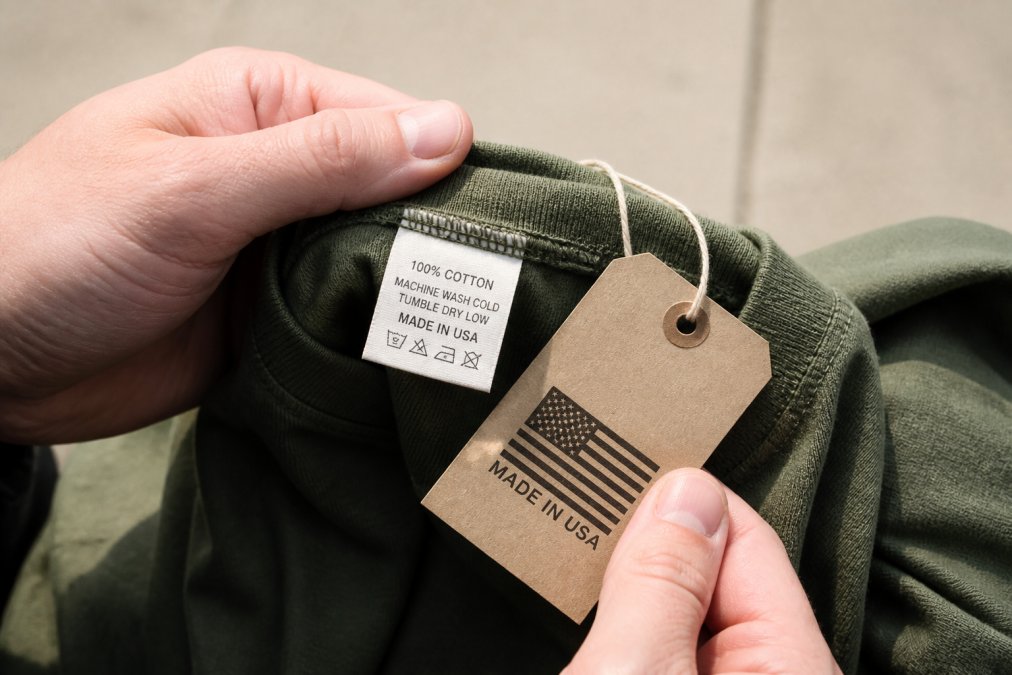
A hang tag is not the same as a permanent label. Hang tags are marketing and can say nearly anything. The sewn-in label is the one bound by labeling requirements. Under the FTC's textile rules, apparel must carry a permanent label with the country of origin, and the fiber content and care instructions must be disclosed either on that permanent label or on a separate temporary one. If the country of origin only appears on a hang tag or a sticker, that is a red flag, not a shortcut.
The Four Elements of a Compliant Label
A properly labeled garment gives you four pieces of information you can act on:
- Country of origin, the phrase the FTC enforces. Look for "Made in USA," "Assembled in USA," or a qualified claim like "Made in USA of imported fabric."
- Fiber content, listed by percentage and in descending order of weight. "100% cotton" and "60% cotton / 40% polyester" tell you very different things about where the raw material likely came from.
- RN number or WPL number, the identifier that ties the garment to a registered business.
- Care instructions, required, and a useful tell: a label that omits care instructions is often a label that was never reviewed for compliance.
RN Numbers and Where to Look Them Up
An RN number is a registration number the FTC issues to businesses that manufacture or import textiles. You can look it up in the FTC's RN database to identify the company responsible for the garment. A legitimate domestic brand will have one, and it will match the brand on the tag.
A WPL number works the same way for businesses that registered before the RN system. Either one is acceptable. What matters is that the number resolves to a real, registered company, not a shell name that appears nowhere else on the garment.
Material Sourcing vs. Assembly: The Nuance Most Shoppers Miss
This is where the label gets genuinely tricky, and where almost no other guide goes deep. "Made in USA" requires that all or virtually all of the garment's significant parts and processing be domestic, that includes the fabric itself, not just the sewing. "Assembled in USA" only requires that the pieces were joined here. The raw material can be entirely foreign.
That distinction matters most for natural fibers:
- Cotton, the fiber may be grown domestically, but the spinning, weaving, and dyeing often happen overseas. A shirt can be sewn in the United States from fabric woven abroad and still carry a qualified claim.
- Wool, domestic wool exists, but much of it is shipped overseas for scouring and spinning before returning as fabric. A "Made in USA" wool garment typically means the whole chain stayed here.
- Synthetic fibers, polyester and nylon are almost always produced overseas, which is why a truly domestic synthetic garment is rare and usually commands a premium.
If a brand claims "Made in USA" on a cotton or wool garment, the honest ones will tell you where the fiber was grown and where the fabric was woven. If they can't answer that, the claim is doing more work than the supply chain is.
How to Verify Brand Claims Beyond the Hang Tag
Verification is the step most shoppers skip, and it is the one that separates confidence from hope. A brand's claim should be traceable to something you can check independently. The good news is that the tools exist, most shoppers just don't know where they are.
The Verification Tools That Actually Exist
These are the concrete resources you can use, in roughly the order of how much they tell you:
- The FTC's RN database, the authoritative lookup for the business behind a garment. If the RN number on the label doesn't resolve, the claim is already in trouble.
- The FTC's Made in USA Labeling Rule page, the primary source for what an unqualified claim legally requires. Reading the rule once makes every subsequent label easier to judge.
- The FTC's business guidance on "all or virtually all", the standard the agency uses to evaluate claims, written for companies but readable by consumers.
- The Consumer Product Safety Commission's recall database, useful for checking whether a brand has a history of mislabeling or safety issues.
- The U.S. Customs and Border Protection rulings database, for imported goods, CBP publishes classification and origin rulings that can confirm or contradict a brand's story.
- State-level "Made in USA" statutes, a number of states have their own labeling laws that are stricter than the federal rule. A brand selling in those states has to comply with both.
What Supply Chain Transparency Actually Looks Like
What most guides miss is that supply chain transparency is voluntary beyond the label itself. Brands that publish their mills and factories are choosing to be verifiable. That choice is a signal.
A genuinely transparent brand typically publishes at least three of the following:
- The names and locations of the mills that produce its fabric
- The names and locations of the factories that cut and sew its garments
- A sourcing statement that distinguishes between fiber origin, fabric origin, and assembly location
- Third-party certifications, such as those from organizations that audit textile supply chains
- A contact method for sourcing questions that reaches a human, not a form
A brand that publishes none of these is not necessarily lying. It is simply asking you to take its word. That is a different thing from proof.
A Practical Verification Workflow
Here is the sequence that works, in order:
- Read the sewn-in label first. Country of origin, fiber content, RN number.
- Look up the RN number in the FTC database. Confirm the company matches the brand.
- Search the brand's site for a sourcing or supply chain page. If it exists, read it for specific mill and factory names.
- Check the fiber content against the claim. A "Made in USA" claim on a 100% polyester garment deserves more scrutiny than the same claim on a domestic wool garment.
- Cross-reference the brand against the CPSC recall database if you are buying at scale or reselling.
- Contact the brand directly with a specific question: "Where was the fabric woven?" Vague answers are themselves information.
The Signal in the Silence
The most useful verification tool is not a database. It is the brand's willingness to answer a specific question with a specific answer. A brand that can name its mill and its factory is almost always telling the truth about origin, because the details are checkable. A brand that answers every sourcing question with a paragraph about heritage is telling you something too, just not about origin.
What the Best American Made Clothing Brands Get Right
The best American made clothing brands share a few habits that make verification easy rather than exhausting. They name their domestic mills. They keep the RN number visible. They use permanent labeling instead of relying on hang tags. And they don't lean on "Designed in USA" when they mean something stronger.
Ironclad Supply builds its apparel around that same discipline. Every detail is refined before it carries the Ironclad name, and the gear is designed for people who prepare today to be ready tomorrow. That standard is the point: durable materials and superior craftsmanship are not marketing lines, they are the reason the label can be printed honestly.
Common Mistakes That Lead to Misleading 'American-Made' Buys
The biggest mistake is treating "American" as a single claim when it is really a spectrum. A brand can be American-owned, American-designed, and American-assembled while still importing nearly everything that gives the garment its structure.
- Confusing the brand's headquarters with the manufacturing location
- Trusting a hang tag over the sewn-in label
- Assuming "premium" pricing implies domestic production
- Skipping the RN lookup because the label "looks official"
Conclusion
The gap between a real domestic garment and a cleverly worded one is usually a single line of stitched text. Learn to read it, check the RN number, and demand sourcing you can verify. Ironclad Supply provides premium apparel forged for those who refuse to stand idle. Our gear is meticulously designed for individuals who value discipline, preparedness, and the protection of what matters most, family, freedom, and community. By combining durable materials with a commitment to superior craftsmanship, we ensure every piece meets the highest standards of quality. Prepare today and stay ready for tomorrow with apparel that reflects your purpose. SHOP THE COLLECTION
Frequently Asked Questions
What does the 'Made in USA' label actually mean legally?
The Federal Trade Commission requires that any product labeled 'Made in USA' be 'all or virtually all' made in the country. That means all significant parts and processing must be of domestic origin, and final assembly must happen here. A brand cannot claim it if the garment was cut and sewn overseas or if key materials like fabric were imported. The FTC can investigate and penalize false claims under its labeling rules.
What is the difference between 'Made in USA' and 'Assembled in USA'?
'Made in USA' means all or virtually all inputs and labor are domestic. 'Assembled in USA' only means the final product was put together here, even if every component was imported. A shirt assembled domestically from foreign fabric and thread can carry that label. For buyers who want true domestic production, 'Assembled in USA' is a weaker claim and worth questioning before you spend.
How can I verify if a clothing brand is truly American-made?
Check the FTC's online complaint database and look up the brand's RN number, which identifies the manufacturer. Request supply chain transparency details from the brand directly, including where fabric is milled and where sewing happens. Look for third-party certifications like those from domestic textile trade groups. If a brand cannot answer where its raw materials come from, treat the 'American-made' claim as unverified.
Why is it difficult to identify if clothing is manufactured domestically?
Most apparel involves multiple stages: fiber growing, yarn spinning, fabric milling, cutting, sewing, and finishing. A garment can pass through several countries before it reaches a store. Brands are only required to disclose the country of origin, not the full supply chain. That gap lets some companies use vague language like 'designed in USA' while manufacturing overseas, which is why label verification takes more than a quick glance.