

How to Identify Durable Tactical Apparel
Table of Contents
- What You'll Need Before You Evaluate Tactical Apparel
- How to Identify Durable Tactical Apparel: Start With the Fabric
- Tactical Gear Stress Point Reinforcement: Where Gear Fails First
- Choosing the Best Tactical Pants for Rugged Tasks
- Moisture-Wicking, Breathability, and Weather Resistance
- MIL-SPEC, NFPA, and What Tactical Gear Standards Actually Require
- Care and Maintenance That Extends Durable Tactical Apparel
- Common Mistakes When Judging Tactical Apparel Quality
- Frequently Asked Questions
Last Updated: September 14, 2026
What You'll Need Before You Evaluate Tactical Apparel
You do not need a lab to judge durable tactical apparel, just a light source, a magnifying glass, and a willingness to inspect construction instead of marketing copy. Most shoppers judge gear by feel and brand name, then discover the truth the hard way: a blown seam, a zipper that quits halfway up, fabric that pills after one season.
Experienced buyers inspect five things first: fabric weave, stitch density, bar-tack placement, hardware quality, and range-of-motion design.
Apply that standard to any tactical pants, shirt, or jacket you consider.
How to Identify Durable Tactical Apparel: Start With the Fabric
Fabric decides how long a garment survives; stitching, hardware, and fit either support it or expose its weaknesses. "Look for ripstop or canvas" is not enough, test what is in your hands, because the tag can say anything.
A durable tactical pant uses a synthetic blend or tightly woven canvas, not thin cotton twill. Hold it to a light source: if you can see through it easily, it will not hold up to field abrasion. Tight, uniform weaves with no visible gaps resist tearing better than loose, open ones.
Four Field Tests You Can Run Without a Lab
These quality-control checks need no equipment beyond what is in your pocket.
1. The two-hand tear test (warp vs. weft). Grip the fabric with both hands about two inches apart and pull steadily, first perpendicular to the weave, then parallel. A durable tight weave resists both directions roughly equally; if one gives noticeably more, the fabric is unbalanced and will fail along that axis first. Test a flat panel, not a seam.
2. The fingernail snag test. Drag a fingernail firmly across the surface at a 45-degree angle. Fibers that snag, pull, or leave a permanent mark indicate loose weave or low-denier yarn and will pill within weeks. A tight weave shows a faint track that recovers when smoothed.
3. The light-transmission test. Hold the fabric against a bright window or phone flashlight. A dense tactical weave blocks nearly all light; if you can read text through it, abrasion resistance will be poor.
4. The rub-and-pill test. Fold the fabric against itself and rub the faces together firmly for about 30 seconds, then inspect. Loose surface fibers ball up immediately, this simulates friction at the inner thigh, under a belt, and against a pack strap.
Reading the Fabric Spec Sheet Like a Buyer, Not a Marketer
Denier is yarn weight, higher generally means thicker, tougher fiber, so 500D nylon outlasts 210D. But denier alone is not durability: a 500D loose weave can fail faster than a 330D tight weave. Look for denier paired with a stated weave structure.
Tear strength and abrasion resistance are separate properties. Tear strength measures how hard it is to propagate an existing rip; abrasion resistance measures how long the surface survives rubbing. A garment can be strong in one and weak in the other, ripstop nylon has excellent tear strength but only moderate abrasion resistance.
Ripstop vs. Canvas: Which Weave Holds Up Longer
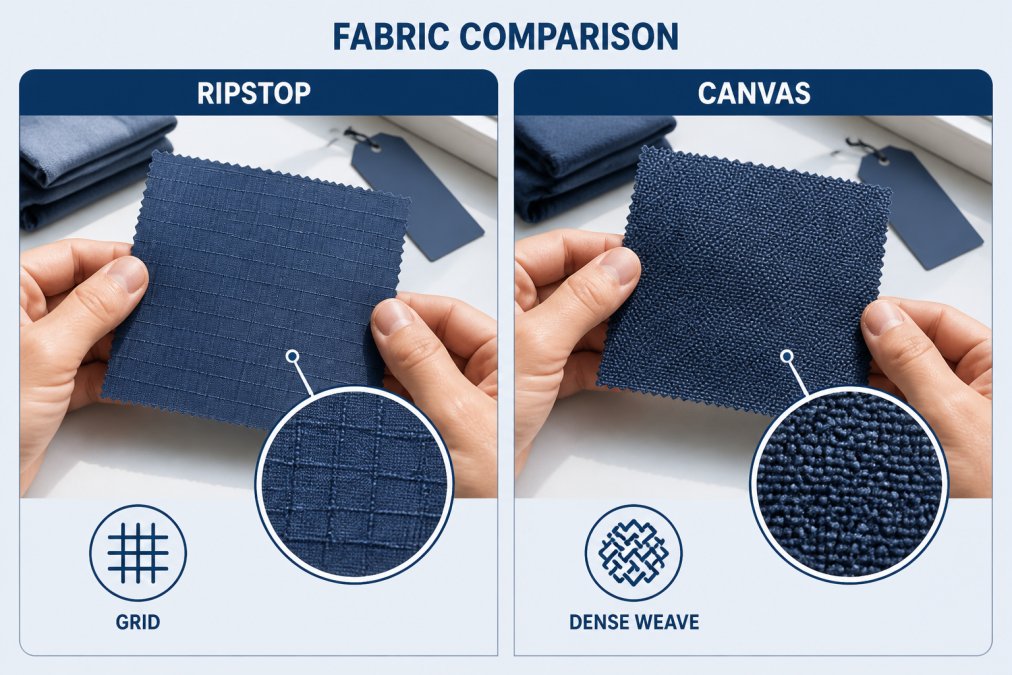
Ripstop uses a crosshatch reinforcement grid woven into the material that stops small tears from spreading. Canvas is a dense plain or twill weave with high tensile strength but no built-in tear-stopping structure.
Which wins depends on use. Ripstop is lighter, dries faster, and handles snags from brush and wire. Canvas is heavier, more abrasion-resistant against concrete and rock, and slower to dry. Many buyers choose ripstop for movement and canvas for stationary heavy work.
A Practical Tactical Clothing Fabric Comparison
| Fabric Type | Best For | Key Strength | Main Trade-Off |
|---|---|---|---|
| Ripstop nylon | Brush, wire, movement | Tear resistance | Less abrasion resistance |
| Cotton canvas | Heavy stationary work | Abrasion resistance | Slow to dry |
| Stretch-woven blend | Active field use | Range of motion | Moderate durability |
| Synthetic blend | Wet, humid conditions | Quick-drying | Can pill with friction |
Tactical Gear Stress Point Reinforcement: Where Gear Fails First
Tactical gear stress point reinforcement means adding extra stitching, fabric layers, or hardware where load concentrates: crotch, knees, belt loops, pocket corners, and shoulder seams. Gear rarely fails mid-panel, it fails where force concentrates.
Check these locations before you buy:
- Crotch and seat: A gusseted crotch, an extra fabric panel sewn in, reduces seam strain during squatting and climbing.
- Knees: Reinforced or double-layered knee panels resist abrasion from kneeling on rough ground.
- Belt loops: Wide, bar-tack reinforced loops handle heavy belt loads without tearing.
- Pocket corners: Bar-tack reinforcement at pocket stress points prevents blowouts.
Stitching, Bar-Tacks, and Hardware Inspection
Stitch density is the easiest quality signal to check by eye: fine, tight, consistent stitching beats wide, loose stitching every time. Look for double-stitched seams at high-stress areas and bar-tack reinforcement at pocket corners and belt loops.
Hardware deserves the same scrutiny: metal zippers rather than plastic, snaps that feel solid without play, zippers that glide without catching and have a locking pull, and rivets and grommets free of burrs or looseness.
Choosing the Best Tactical Pants for Rugged Tasks
The best tactical pants for rugged tasks balance fabric durability, reinforced construction, and ergonomic fit. Miss the third and the first two barely matter, a pant that restricts movement gets damaged faster by the wearer than by the terrain.
Look for articulated knees, knee panels cut and sewn with a bend built in, which follow the leg's natural flex instead of fighting it. Gusseted crotches and stretch-woven panels at the hips and thighs add further range of motion.
Range of Motion, Articulated Knees, and Ergonomic Fit
Test fit by squatting, kneeling, and stepping onto a low surface. If fabric pulls tight across the knee or seat, the cut is wrong for field work, ergonomic fit means the garment moves with you under load, not just while standing still.
Pocket layout matters too. Deep, reinforced front and rear pockets plus dedicated utility or cargo pockets give tactical utility without bulging. Check that flaps stay closed when you run and nothing digs into your hip when you sit.
Moisture-Wicking, Breathability, and Weather Resistance
Moisture-wicking fabric moves sweat to the surface where it evaporates; breathability lets heat and vapor escape; weather resistance keeps wind and light rain out. A durable tactical garment balances all three, because a jacket that blocks rain but traps sweat is useless on a long patrol.
Quick-drying matters most in wet, humid conditions. Synthetic blends dry far faster than cotton, which stays damp and heavy. For water-repellent properties, look for a durable water-repellent finish, and check whether the manufacturer states how many washes it survives.
Thermal regulation is the fourth piece. Layering systems beat a single heavy garment because you can shed or add insulation as conditions change. Look for underarm or back-panel venting and mesh linings that move air.
MIL-SPEC, NFPA, and What Tactical Gear Standards Actually Require
Tactical gear standards are test specifications defining minimum performance for fabric strength, flame resistance, and hardware durability. Two names come up most often: MIL-SPEC and NFPA. The useful part is knowing how to verify a claim and inspect the hardware a spec is supposed to protect.
MIL-SPEC refers to military specifications, documented requirements for materials and construction used in defense procurement. A garment labeled MIL-SPEC should meet defined thresholds for tensile strength, tear resistance, and colorfastness. Specs follow a naming pattern: MIL-DTL, MIL-PRF, and MIL-STD. A real citation is a document number, not a slogan.
NFPA refers to standards published by the National Fire Protection Association, including NFPA 1975, Standard on Emergency Services Work Clothing Elements. That standard covers work clothing worn by emergency responders, including requirements for flame resistance and thermal stability.
Here is the catch most buyers miss: a brand can use the words "military-grade" or "tactical" freely. Neither is a regulated term. If durability claims matter to you, ask for the specific standard number and verify it through the official ASSIST database of military specifications or the NFPA standards catalog. A real standard number is verifiable. A vague claim is not.
How to Verify a MIL-SPEC or NFPA Claim in Five Minutes
- Get the exact document number. "MIL-SPEC compliant" is not a number. Ask for a MIL-DTL or MIL-PRF identifier, or an NFPA standard number with a year (e.g., NFPA 1975, 2019 edition).
- Search the official database. Enter the number into ASSIST for military specs or the NFPA catalog for fire standards. If it returns no document, the claim is unverifiable.
- Check the scope. A spec may cover only one component, a zipper, thread, or fabric, not the finished garment. A jacket can contain MIL-SPEC fabric and still fail at the seams.
- Look for the test method. Real specs name the test and the threshold; marketing copy rarely does.
- Confirm the edition. Standards are revised, and a garment citing a superseded edition may not meet current requirements.
Hardware Inspection: Where Specs Meet Reality
Standards protect fabric and the finished garment, but hardware is the most common point of failure and the least inspected. Run these checks before you buy.
Zippers. Look for metal teeth on load-bearing zippers (main closure, cargo pockets); plastic coil is fine for low-stress use but fails faster under repeated load. The slider should glide without catching, and a locking pull should hold position when you tug the tape. Check that the tape is sewn, not glued, into the seam, and that the top and bottom stops are metal.
Buttons and snaps. Press a snap closed and pull it apart several times. Quality snaps seat with a firm, audible click and release without play; if the snap rocks side to side, the prong or post is undersized and will pull through the fabric. Buttons should be sewn with a shank or cross-stitch, not a single thread loop.
Buckles and adjusters. On belts, straps, and pack-compatible gear, flex the buckle. Metal should return to shape; plastic that whitens at the stress point is already fatiguing. Check that the teeth or grip surface engages the webbing without slipping under load.
Rivets and grommets. Inspect for burrs, sharp edges, and looseness. A rivet that spins freely has already lost its grip and will tear out.
Care and Maintenance That Extends Durable Tactical Apparel
Washing correctly adds years to a garment's life, and most people get it wrong. The routine that works:
- Wash in cold water on a gentle cycle to reduce fiber breakdown
- Turn garments inside out to protect the outer face from abrasion in the drum
- Skip fabric softener, which coats wicking fibers and blocks breathability
- Use mild detergent, not bleach, which weakens synthetic fibers
- Air dry when possible; if using a dryer, choose low heat
- Reapply water-repellent treatment when water stops beading on the surface
- Repair small tears immediately before they spread
Field care matters too. Brush off dried mud instead of scrubbing it wet, since wet scrubbing drives grit into the weave. Inspect zippers and snaps after hard use, and clear grit from zipper teeth with a soft brush.
Common Mistakes When Judging Tactical Apparel Quality
The biggest mistake is judging by weight alone. Heavy does not mean durable. A thick, loosely woven cotton pant can fail faster than a lighter, tightly woven synthetic blend.
The second is trusting the label over the seam. "Tactical" and "military-grade" are marketing terms with no legal definition; construction tells the truth through stitch density, bar-tacks, hardware, and reinforcement placement.
The third is ignoring fit, a garment that binds at the knee or shoulder gets stressed every time you move, and stress kills gear. The fourth is skipping hardware inspection: cheap zippers and snaps fail long before the fabric does and are the most common warranty complaint in the category.
Finally, buyers overlook care. A well-built garment washed with softener and dried on high heat will underperform a mid-tier garment cared for properly. Construction sets the ceiling. Maintenance decides whether you reach it.
Most gear failures trace back to one decision at the point of purchase: trusting a label instead of inspecting construction. Ironclad Supply builds apparel for people who prepare today to be ready tomorrow, with every detail refined before it carries our name. Our gear uses durable materials and reinforced construction at the stress points that matter, for those who value discipline, preparedness, and the protection of what matters most.
Get started with Ironclad Supply and gear that holds up when it counts.
Frequently Asked Questions
What materials make tactical clothing the most durable?
Look for ripstop nylon, cotton-nylon blends, and stretch-woven fabrics with abrasion-resistant panels in high-wear zones. Ripstop fabric uses a crosshatch reinforcement grid that stops tears from spreading. Tensile strength and tear resistance matter more than brand claims, so check for stated fabric weight and construction details. Synthetic blends with moisture-wicking properties hold up better across repeated wash cycles than 100% cotton.
How can you tell if tactical pants are high quality?
Inspect the stitching first: double-stitched seams, bar-tack reinforcement at pocket corners and belt loops, and heavy-duty hardware like YKK zippers signal real durability. Check for articulated knees that support range of motion and reinforced knees and seat panels. Run your hand along the inside seams for loose threads or skipped stitches. A garment built for load-bearing will show consistent construction throughout, not just on visible exterior panels.
Should tactical apparel be ripstop or canvas?
Both work, but they serve different needs. Ripstop fabric is lighter, quick-drying, and resists tearing once a puncture starts because of its reinforcement grid. Canvas is heavier, more abrasion-resistant, and better for cold-weather or heavy brush environments. For most field use, a ripstop or stretch-woven synthetic blend offers the best balance of weight, breathability, and tear resistance. Canvas wins when maximum abrasion resistance matters more than weight.
How do reinforced stress points improve tactical gear longevity?
Stress points like crotch gussets, knee panels, pocket corners, and belt loops take the most load during movement. Bar-tack reinforcement and double-stitched seams at these spots prevent the fabric from pulling apart under tension. Without reinforcement, these areas fail first, often within months of regular use. When evaluating durable tactical apparel, run your fingers along these zones and feel for thicker stitching and added fabric layers.